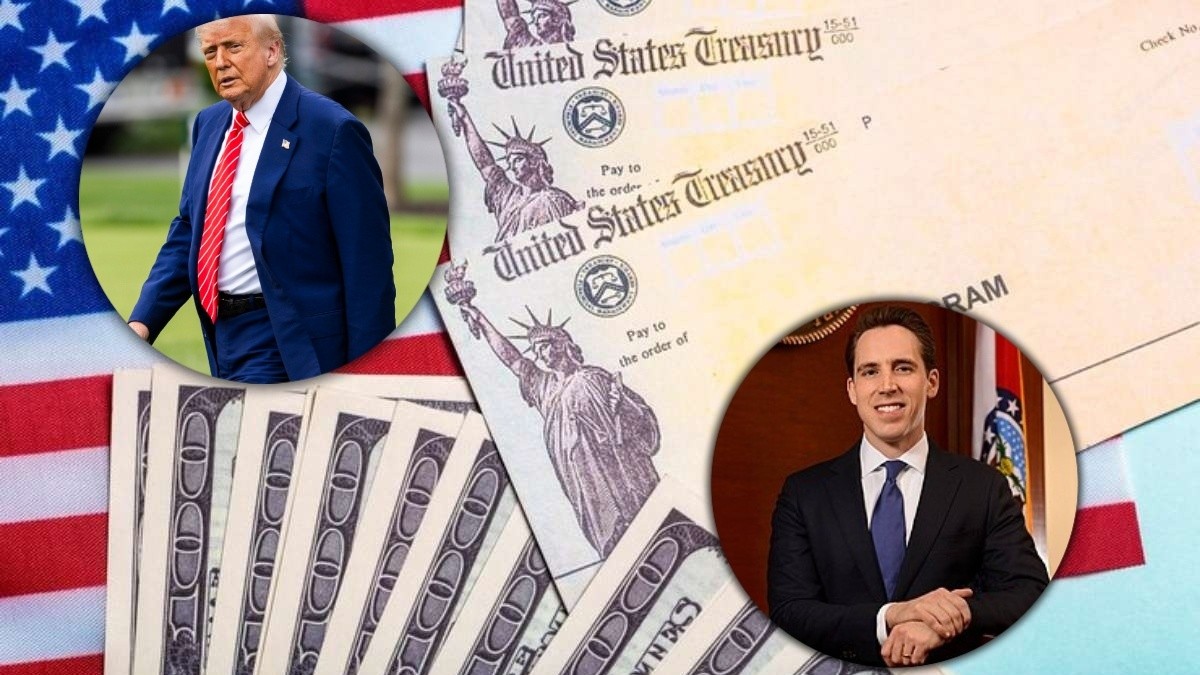
A new federal proposal is reigniting debate over government-issued stimulus checks, as policymakers explore alternative ways to return revenue to American households. At the center of the conversation is a bill that would distribute tariff-generated funds directly to citizens, a plan that could provide timely relief for families but also carries significant potential drawbacks.
The proposal, formally known as the American Workers’ Tariff Rebate Act of 2025, was introduced by Senator Josh Hawley (R-MO). It outlines a system of direct government payments funded not by borrowing, but by U.S. tariff revenue. Under the bill, adults and dependent children would each receive a minimum of $600, with payments increasing if tariff revenues exceed expectations. A family of four, for instance, would receive no less than $2,400.
This idea has found support at the executive level. President Donald Trump, speaking recently to reporters, said there was “a good amount of money coming in from tariffs”, hinting at the possibility of rebating these funds directly to Americans. Indeed, the U.S. Treasury reported a surprise revenue bump in June, including roughly $27 billion in customs duties, a 301% increase from June 2024.
At first glance, the plan resembles the CARES Act payments made during the COVID-19 pandemic, which sent checks to millions of households in 2020. However, the proposed 2025 version differs in both funding source and political context. It is being promoted not as emergency relief, but as a redistribution of revenue from trade tariffs that, according to its backers, disproportionately burden American consumers.
Still, significant challenges lie ahead…
First, the political viability of the bill remains uncertain. While Hawley and Trump appear aligned on using tariff income for rebates, many within the Republican Party may not support the diversion of federal revenue away from deficit reduction. Fiscal conservatives, in particular, may resist the idea of repurposing funds to increase government spending, even in the form of direct payments.
Second, economists are warning of the potential for inflationary effects. Joseph Rosenberg, senior fellow at the Urban-Brookings Tax Policy Center, told CNBC that sending out additional government checks could boost consumer demand and drive prices higher. “More money chasing the same goods”, he noted, can quickly translate to increased inflation, especially in a still-sensitive post-pandemic economy.
This concern is not unfounded. Following the 2020 CARES Act, inflation rose by an estimated 2.6%, as a result of stimulus-driven consumer activity. While the economy eventually stabilized, critics argue that introducing a new round of checks in 2025 could reignite inflationary pressures, undermining recent progress in curbing price increases.
There is also the structural issue of relying on tariff income. While June's customs revenue surge provides a snapshot of short-term potential, tariffs are volatile and dependent on trade policy, global markets, and import behavior. Basing household income on such a variable source could make future payments unreliable, and in years of lower trade volume, the rebate promise may fall short or disappear entirely.
Moreover, economists often emphasize that tariffs function as indirect taxes on consumers, increasing the cost of imported goods. Rebating that money back to consumers, then, may simply offset the higher prices they already paid, rather than creating new economic value or meaningful savings.
In sum, while the idea of a new $600 check may be politically attractive and offer immediate financial relief, it faces an uphill battle. Political resistance, inflationary risks, and the uncertain nature of tariff revenue all pose serious questions about its long-term viability. As the proposal moves into legislative debate, lawmakers will need to weigh short-term gains against broader economic impacts, and consider whether the cost of a quick cash infusion is worth the risk.